A STUDY BY JOHN T JEFFERSON

Geometry has
a direction.

A path can curve as it enters a region, then leave along a straight line. Explore the geometry behind that asymmetry.

THE SMOOTH FINSLER SHELL

F(x, y) = α [1 + A(r) q(s)]

A prescribed spatial geometry with exact relations for directional length and scattering.

Background
Euclidean space
Correction
Smooth · inward only
Explore
Paths · norms · angles

01 / THE EXPERIMENT

Follow a path through the shell.

Adjust the inward correction.
Compare the path with Euclidean motion.

GEODESIC SIMULATION Incoming
Trajectory through a directional Finsler shell A teal geodesic enters from the left. A dashed line shows the Euclidean reference. The shell occupies radii one to three. Origin x / ℓ y / ℓ r = 3ℓ r = ℓ
Finsler geodesic Euclidean reference Shell region
Distances use the shell scale ℓ. Playback follows the geodesic parameter.Adaptive geodesic integration · exact reference relations

02 / TWO VIEWS OF THE SAME MODEL

From direction to deflection.

Both diagrams respond to the shell amplitude.

A

Equal length, different steps.

Unit-norm contour at the shell peak, r = 2ℓ.

Unit Finsler norm contourThe outward half remains a unit semicircle. The inward half contracts as the shell amplitude increases.
Inward radial step0.731
Outward radial step1.000

Each point represents a tangent vector with F = 1. The contour describes directional length, not the shell’s physical shape.

B

One shell. A family of paths.

Excess angle across incoming offsets.

Excess scattering angle versus impact parameterA curve shows the excess angle for the selected amplitude. The selected impact parameter is marked. The angle is zero outside the shell.
b / ℓ = 1.00 · δ = 21.8706°Select a point to set b.

The curve follows the conserved angular-momentum relation. The trajectory above follows the Cartesian geodesic equations.

03 / WHAT THE MODEL SAYS

Three precise consequences.

Definitions and proofs
01

Direction changes length.

The correction acts only on inward tangent vectors. It vanishes smoothly at tangent and outward directions.

Fin / α = 1 + A / e Radial inward motion
02

Closest approach stays fixed.

For nonradial paths, the minimum radius equals the incoming impact parameter. The excess angle still changes with the correction.

rmin = b
03

A radial path crosses the center.

A bounded correction changes radial speed. The Cartesian path continues through the origin without reflection.

THE RESEARCH

An explicit model.
An inspectable calculation.

Read the definitions and proofs. Reproduce the numerical results with the complete source package.

04 / THE AUTHOR

About the Author

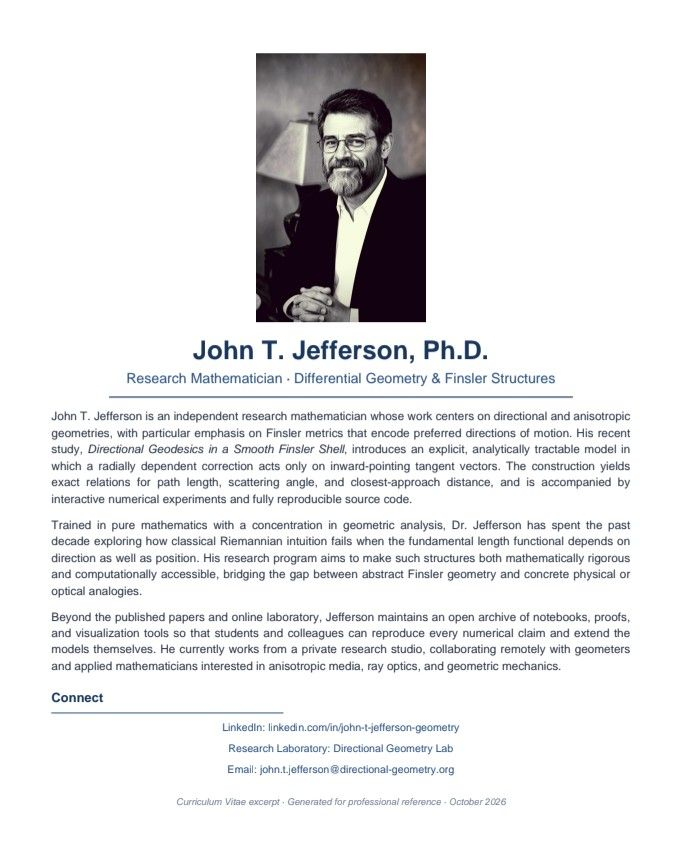
Portrait of John T. Jefferson
John T. Jefferson, Ph.D.Research Mathematician
View author profile

Differential Geometry & Finsler Structures

John T. Jefferson is an independent research mathematician whose work centers on directional and anisotropic geometries, with particular emphasis on Finsler metrics that encode preferred directions of motion. His recent study, Directional Geodesics in a Smooth Finsler Shell, introduces an explicit, analytically tractable model in which a radially dependent correction acts only on inward-pointing tangent vectors. The construction yields exact relations for path length, scattering angle, and closest-approach distance, and is accompanied by interactive numerical experiments and fully reproducible source code.

Trained in pure mathematics with a concentration in geometric analysis, Dr. Jefferson has spent the past decade exploring how classical Riemannian intuition fails when the fundamental length functional depends on direction as well as position. His research program aims to make such structures both mathematically rigorous and computationally accessible, bridging the gap between abstract Finsler geometry and concrete physical or optical analogies.

Beyond the published papers and online laboratory, Jefferson maintains an open archive of notebooks, proofs, and visualization tools so that students and colleagues can reproduce every numerical claim and extend the models themselves. He currently works from a private research studio, collaborating remotely with geometers and applied mathematicians interested in anisotropic media, ray optics, and geometric mechanics.